

What is Agentic AI? (And Can I Build It In Java?)

We see this question constantly in developer forums: "I want to build a resume project showcasing frontend, backend, and Agentic AI. My strongest backend language is Java, but frameworks like LangChain and CrewAI only seem compatible with Python. If I write the logic myself in Java, am I just mimicking an agent, or am I building one?"
It is a fantastic question that highlights a massive misunderstanding in the software community right now. Python’s dominance in the AI space has led many developers to believe that "Agentic AI" is a specific Python library or framework.
Using the Feynman Technique—breaking complex concepts down to their simplest truths—let’s decode exactly what an agent is, and explore two structural blueprints for integrating AI into a Java-based enterprise stack.
Level 1: Unmasking the Magic (What is Agentic AI?)
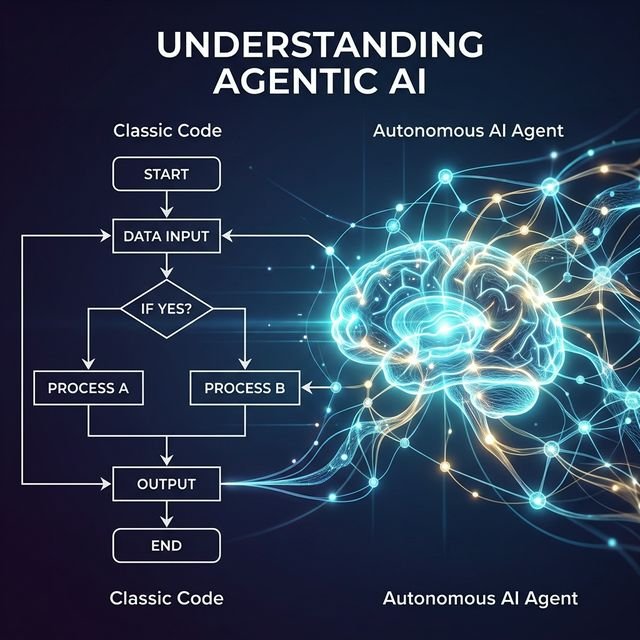
When marketing teams say "Agentic AI," they make it sound like a completely new form of artificial life. In reality, Agentic AI is just an architectural software design pattern.
At its absolute core, an AI Agent is simply:
- 1. An LLM API: Like ChatGPT or Claude.
- 2. Memory / State: A database storing previous chat steps.
- 3. Tool Calling: Functions the LLM is allowed to execute (like searching the web or querying a database).
- 4. An Orchestration Loop: A while-loop that refuses to end until a goal is met.
If you string together an LLM, a database, some API tools, and a while-loop, you have built an agent.
Level 2: The Core Loop (Reason, Act, Observe, Adapt)
Whether you use Python or Assembly Language, every AI agent executes the exact same "interleaved thinking" loop. If you ask an agent to "Find the weather in Tokyo," the loop looks like this:
1. Reason: The LLM decides it needs weather data.
2. Act: The LLM signals your code to execute the "Weather API" tool.
3. Observe: Your code feeds the API result back into the LLM.
4. Adapt: The LLM reads the result, realizes the task is complete, and generates a final user response.
This loop is not language-specific. Writing a custom loop in Java using an LLM API does not mean you are "mimicking" an agent. You are writing an agent from scratch.
The Infographic: Java vs. Python Architecture
- [Python Frameworks]: You import LangChain -> Provide Tools -> Call `agent.run()`. All the loops are hidden in their source code.
- [Java Implementation]: You create a REST API to OpenAI -> Write your own `while (!taskComplete)` loop -> Execute Java functions when the LLM asks for a tool.
Level 3: Two Ways to Build it in Java
If you want to build a resume project using your Java skills, you have two incredibly valid architectural paths to choose from.
Path 1: The Native Java Approach
As discussed above, you don’t need Python. You can build the entire orchestration in Java. You create a Spring Boot application, establish a connection to OpenAI or Anthropic via HTTP, parse the JSON returned, and write Java code to execute any tools the LLM requests. This proves to employers you deeply understand the underlying mechanics of AI.
Path 2: The Polyglot Microservices Approach
Sometimes, you are under a tight deadline and just want to use the pre-built speed of Python frameworks. In this case, use a microservices architecture.
Use Java (Spring Boot) to handle the heavy backend lifting: User authentication, complex database transactions, and frontend API serving. Then, create a lightweight Python "Worker" application that specifically runs the LangChain/CrewAI logic. Your robust Java backend sends a simple REST call or a RabbitMQ/Kafka message to the Python worker, which executes the AI workflow and returns the result.
This is a phenomenal resume project because it mirrors exactly how massive enterprise companies manage polyglot (multi-language) system clusters.
Level 4: Resume Project Ideas
Looking for a project to combine a React Frontend, Java Backend, and Agentic AI? Try building:
- 1. The Enterprise Meeting Orchestrator: A React dashboard where users upload meeting audio. Your Java backend authenticates the user, stores the file, and pings a Python worker to transcribe and extract highly structured Jira tickets using an LLM. The Java backend then saves the tickets and pushes them to the UI.
- 2. The Smart Support Router: A Java-based email ingest server that receives client emails and pushes them through a native Java "Reason/Act" loop. The LLM identifies the department, tags the urgency, and your Java application automatically creates a ticket in Zendesk via their API.
Conclusion: Logic Over Language
Do not feel restricted by the Python hype machine. "Agentic AI" is mostly just LLMs + memory + tool calling + orchestration. A strong developer who understands software architecture patterns can build an automation agent in any modern programming language.
Ready to build real multi-language AI architectures? Join our Agentic AI Developer Bootcamp to learn the design patterns behind native orchestration and Python microservice workers.
Suggested reading


Frequently Asked Questions
What exactly is Agentic AI?
Agentic AI is essentially a Large Language Model (LLM) connected to tools and memory, running in a continuous loop. It follows a simple pattern: Reason, Act, Observe, and Adapt, repeating this loop until its assigned goal is completed.
Do I have to use Python to build AI agents?
No. Agentic AI is an architectural pattern, not a language-specific feature. While Python has more pre-built orchestration frameworks (like LangChain or CrewAI), the core logic loop can easily be built in Java, Go, or TypeScript.
Is writing a custom LLM loop in Java considered "mimicking" an agent?
Not at all. A hard-coded "Reason -> Act -> Repeat" loop using an LLM API in Java is literally the exact same mechanism powering Python libraries under the hood. It is a genuine, functioning AI agent.
Live masterclasses
Enroll in our live masterclasses programs: Build real AI agents or your first data-science model with expert mentors.
Agentic AI Developer Bootcamp
Structured agentic AI and LangGraph training — intensive bootcamp-style projects with mentor support.
Duration: 2 days, 5 hours each day.
Explore Agentic AI Course →Data Science Masterclass
Start your data science journey with a structured live masterclass and hands-on model building.
Duration: 2 days, 5 hours each day.
Data Science Masterclass →