

What the heck: Agentic AI???

Imagine you’re the boss of a very capable, but very new employee. If you ask a standard AI to "write a report," it will just spit out some generic text based on what it knows. But if you have an "Agentic AI" under your command, it acts like a true autonomous worker.
What the heck is Agentic AI? Is it just the latest buzzword, or does it actually change how we work? Let's break it down using the Feynman Technique: removing the jargon so anyone—even a beginner—can understand exactly how AI agents operate.
Level 1: The Simple Analogy (Like Explaining to a Kid)
Think of a traditional AI (like a normal chatbot) as a very smart encyclopedia. You ask a question, it gives an answer. It’s brilliant, but it’s passive. It cannot DO anything in the real world.
Now, think of Agentic AI as a robot butler. You don’t just ask it a question; you give it a goal. If you say, "Bake me a cake," the robot butler doesn't just hand you a recipe. Instead, it checks the fridge for ingredients, goes to the store to buy flour, comes back, mixes the batter, and bakes the cake.
In the digital world, an Agentic AI (or AI Agent) takes your goal, makes its own plan, uses tools (like a web browser or a calculator), and takes actions until the job is done.
Level 2: Peeking Under the Hood
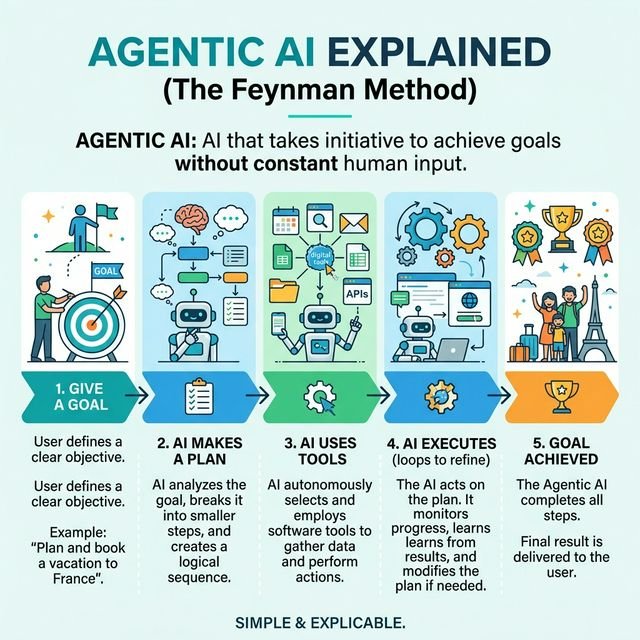
How does an AI agent actually pull this off? It relies on a simple, repeating loop of thinking and acting. We can break this down into four core pillars:
- 1. The Goal: You provide the ultimate objective. For example, "Find the best flight to Tokyo under $800."
- 2. Reasoning & Planning: The AI breaks the massive goal into bite-sized steps. It thinks: "First, I need to check flight dates. Second, I need to open a travel website. Third, I need to extract the prices..."
- 3. Tool Use: This is the game-changer. An AI agent is not trapped in a chat box. It can be given "hands" in the form of APIs. It can use a search engine, run Python code, query a database, or send an email.
- 4. Execution & Reflection (The Loop): The agent executes step one. Then, it checks if it worked. If the travel website block access, it reflects: "Oops, that failed. Let me try a different travel site." It adapts and loops until it hits the goal.
To make this visually crystal clear, take a look at the infographic below which outlines the Agentic AI cycle:
Level 3: Real-World Examples of Agentic AI
To truly grasp the power of Agentic AI, let’s look at a few examples of how they differ from standard GenAI.
Example 1: The Autonomous Customer Support Agent
Standard AI: A customer says, "My package is broken." The chatbot replies, "I'm sorry to hear that. Please email support@company.com for a refund."
Agentic AI: The agent receives the complaint. It uses its built-in tools to securely check the customer's order history in the database. It verifies the tracking number, uses an API to proactively trigger a replacement order in the warehouse system, and sends a customized apology email with the new tracking details. All with zero human intervention.
Example 2: The Data Analyst Agent
If you hand a massive CSV file to a standard AI, it might choke on the context limit. An Agentic AI, however, will write a Python script, execute that script in a secure sandbox, generate a data visualization chart, and compile a beautiful PDF report summarizing the insights.
Example 3: The Software Engineering Agent
Imagine telling an AI: "Build a functioning weather app." An AI agent like Devin or open-source equivalents will open a command line, write the frontend code in React, set up a Node.js backend, debug syntax errors it encounters, and even deploy the final product to a live server. It is practically a digital pair programmer.
Level 4: Identifying the Boundaries (The Challenges)
If Agentic AI is so incredible, why isn’t it doing all our jobs right now? Because autonomy comes with risks. We call these "Edge Cases" and "Hallucinations."
Since the AI has access to tools—like sending emails or deleting files—a single mistake in its reasoning can cause chaos. If an agent misunderstands a prompt, it could accidentally delete a crucial database or send an inappropriate email to a client. This is why "human-in-the-loop" systems are still standard practice for critical tasks. We let the agent do the heavy lifting, but a human approves the final stroke.
Agentic AI gives models "hands," which makes them powerful but requires strict security constraints and oversight.
Summary: Why Agentic AI is the Future
In summary, Agentic AI moves artificial intelligence from being an interactive dictionary into an active participant. By giving AI the ability to reason, formulate plans, and interact with external tools, we are unlocking massive productivity gains.
Remember the Feynman analogy: we are moving from asking a smart encyclopedia to assigning tasks to a capable digital butler. The applications for operations, enterprise IT, and personal productivity are virtually endless.
Ready to build your own agents? Our Agentic AI Developer Bootcamp dives deep into LangChain, LangGraph, and multi-agent workflows so you can become a master of autonomous AI.
Suggested reading


Frequently Asked Questions
What is Agentic AI?
Agentic AI refers to an AI system that acts autonomously to achieve a given goal. Unlike traditional AI, it can plan its own steps, use external tools, and execute actions.
What is an example of an AI agent?
A customer support bot that can process a return, issue a refund, and update the CRM all by itself without human intervention.
How does Agentic AI differ from Generative AI?
Generative AI (like basic ChatGPT) generates text or images based on a prompt and stops. Agentic AI continuously loops through reasoning, planning, and actions to complete complex tasks autonomously without constant human prompting.
Live masterclasses
Enroll in our live masterclasses programs: Build real AI agents or your first data-science model with expert mentors.
Agentic AI Developer Bootcamp
Structured agentic AI and LangGraph training — intensive bootcamp-style projects with mentor support.
Duration: 2 days, 5 hours each day.
Explore Agentic AI Course →Data Science Masterclass
Start your data science journey with a structured live masterclass and hands-on model building.
Duration: 2 days, 5 hours each day.
Data Science Masterclass →