

How Do I Get Started With Agentic AI and Building Autonomous Agents?
It feels like overnight, the entire tech industry—from software engineers to sysadmins at major tech conferences—has shifted its focus to something called "Agentic AI."
We’ve seen the sheer panic. Sysadmins on Reddit asking: "How is no one else freaking out in a technical sense? Where is the learned data being stored? IT used to be black and white—now you’re telling me there is nuance to AI??" If you’re feeling completely new to Agentic AI and wondering how to get started, you are not alone.
Using the Feynman Technique, we are going to break down what Agentic AI really is, strip away the confusing jargon, and provide a beginner-friendly roadmap for building your first autonomous agents.
Level 1: Unpacking the "Virtual Employee" (Feynman Style)
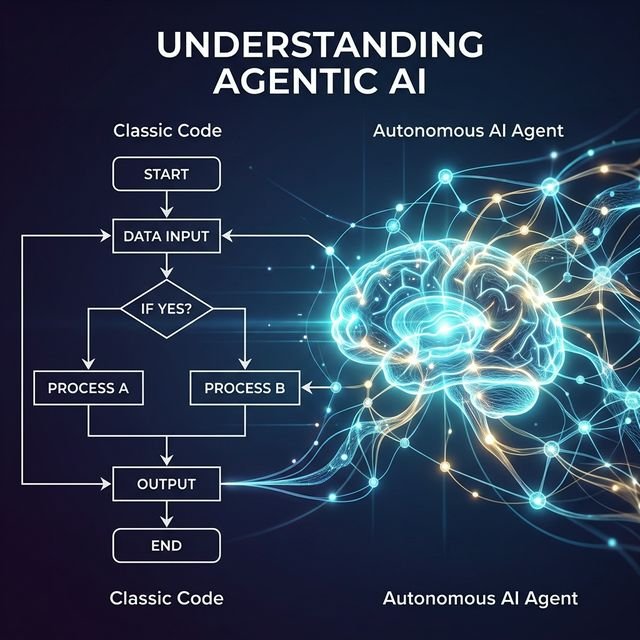
Let’s clear up the mystery. A lot of marketing makes Agentic AI sound like a magical digital brain that just organically learns and evolves. In reality, under the hood, it’s a very logical system design pattern.
Think of an AI agent like a newly hired intern. The intern isn't magical; they just follow a process. Agentic AI is simply:
- 1. The Brain (LLM): A Large Language Model (like GPT-4 ) that understands commands and can reason through problems.
- 2. The Hands (Tools): API connectors that allow the brain to interact with the world (e.g., searching the web, querying a database, or sending an email).
- 3. The Notebook (Storage/Memory): A place to store "learned data" and conversation history, often using a Vector Database. The data doesn’t float in the ether; it lives exactly where you program it to live.
- 4. The Loop (Control flow): A script that continuously tells the AI: "Did you achieve your goal? If not, use a tool, read the result, and try again."
When marketing says you are adding a "virtual employee" to your team, they mean you are deploying this specific combination of LLM + Tools + Storage + Control Loop.
Level 2: The Beginner-Friendly Roadmap
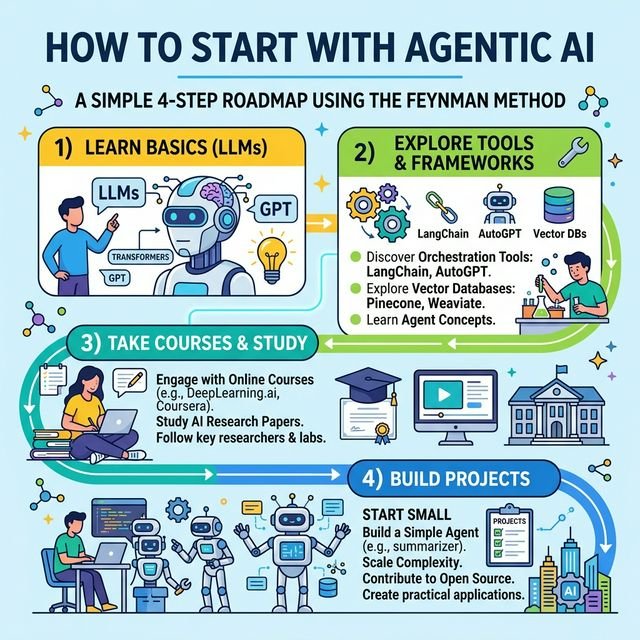
So, how do you actually get started with tools like AutoGPT and LangChain? Here is a step-by-step roadmap gathered from seasoned experts who have built core business automations.
Step 1: The Human "Why" (Goal-Oriented Task Analysis)
Before writing a line of code, remember that the technical "how" is subservient to the human "why." Map out in detail the workflow you hope to automate. Where are the "human in the loop" events? Measuring twice and cutting once will save you hours of frustrating rework.
Step 2: Learn the Core Basics
Get familiar with LLMs and prompt engineering. If you cannot get a model to output the correct response in a standard chat window, you won't be able to get an agent to execute it autonomously. Start with DeepLearning.ai's "AI for Everyone" or "ChatGPT Prompt Engineering for Developers."
Step 3: Explore the Tools & Frameworks
- LangChain & Agno: Perfect for connecting LLMs to APIs and building complex, customized workflows from scratch in Python or TypeScript.
- AutoGPT: Great for quick experimentation with fully autonomous task execution. Just give it a goal and watch how it plans.
- AgentGPT / n8n: Excellent low-code/no-code options. n8n allows you to drag and drop nodes to create powerful agentic flows.
- OpenAI Agent SDK: The official documentation is surprisingly beginner-friendly and will give you a major head start.
Step 4: Take Actionable Courses
Free resources are abundant. HuggingFace offers an excellent free Agents course. On YouTube, search for "Mixture of Agents" or explore the AssemblyAI channel. DeepLearning.ai also features phenomenal short courses on "Building Systems with the ChatGPT API" and "Multi AI Agent Systems with crewAI."
Level 3: Relevant Examples of Agentic Workflows
Start small. Don't try to build an entire company-running AI on day one. Here are practical examples to inspire your first builds:
1. Automating the Back Office (The Junior Paraplanner)
Imagine an independent wealth manager who finishes a client meeting. An AI agent transcribes the audio file, extracts key action items, and automatically plugs that structured data directly into a Notion CRM via an API. Over time, you can expand this agent's tools so it performs all the routine duties of a junior advisor.
2. The Daily Briefing Agent
A great first project is an agent that wakes up at 7 AM, uses a web scraping tool to read the top 5 articles on your favorite tech sites, uses an LLM to summarize them into three bullet points each, and emails them to you. It teaches you scheduling, tool usage, and prompt engineering in one simple project.
3. The Website Manager (Auto-Resolving)
Platforms like WordPress now integrate with agents (like Hostinger's Kodee) that allow you to manage your site through simple AI chats. You instruct the agent: "Optimize my images for web," and the agent searches your media library, applies compression tools, and saves the new versions seamlessly.
4. The Software Developer (Self-Healing Code)
By using VS Code and tools like RooCode or Cursor, you can set up a local agent. You write a failing unit test, and the agent reads the error, modifies your local codebase, and re-runs the test until it passes.
Conclusion: Start Building
The best way to understand Agentic AI isn’t just reading about it; it’s putting your fingers on the keyboard. Open your favorite LLM, describe what you want to build, and let it safely hold your hand through the coding process.
Once you look at the raw code on GitHub and understand that an "Agent" is just code executing a loop of (Prompt -> Tool -> Evaluate), the mystery dissolves. It's not black magic; it's just the next brilliant evolution of software engineering.
If you are looking for structured, hands-on guidance to accelerate your journey, check out our Agentic AI Developer Bootcamp. Learn alongside peers, build real projects, and demystify autonomous agents for good.
Suggested reading



Frequently Asked Questions
What is Agentic AI?
Agentic AI refers to a system design pattern combining an LLM, tools (APIs), storage (memory), and a control loop to create an autonomous "virtual employee" that can plan and execute complex tasks.
How can I start learning Agentic AI?
Begin by understanding general LLM capabilities and prompt engineering. From there, move into introductory courses on Deeplearning.ai or HuggingFace, and experiment with frameworks like LangChain, AutoGPT, or n8n.
Where is an AI Agent's learned data stored?
An autonomous agent typically stores its context and learned data in specialized Vector Databases (like Pinecone) or local memory stores configured by the developer, giving you full control over data privacy.
Live masterclasses
Enroll in our live masterclasses programs: Build real AI agents or your first data-science model with expert mentors.
Agentic AI Developer Bootcamp
Structured agentic AI and LangGraph training — intensive bootcamp-style projects with mentor support.
Duration: 2 days, 5 hours each day.
Explore Agentic AI Course →Data Science Masterclass
Start your data science journey with a structured live masterclass and hands-on model building.
Duration: 2 days, 5 hours each day.
Data Science Masterclass →